Satellite
Networks
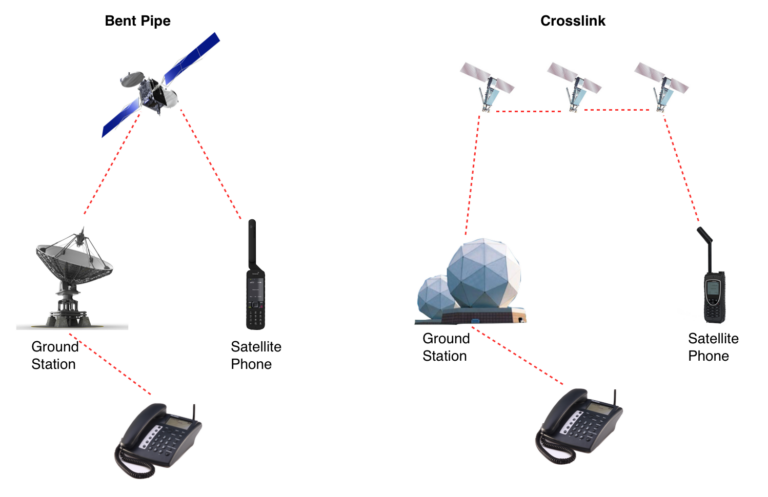
Satellite networks are made up of a group of satellites also known as constellations. These constellations are synchronized and communicate with the network's ground stations. Ground stations receive your calls from the satellite and route them to your land or cellular lines.


Network Technology
The following table tells you important information about our satellite networks.
| Iridium | Thuraya | |
|---|---|---|
|
Orbit Type |
Geosynchronous |
Geosynchronous |
|
Number of Satellites |
66 |
2 |
|
Number of Ground Stations |
4 |
1 |
|
Transmission Technology |
Cross Link |
Bent Pipe |
Orbit Type
How does orbit type impact satellite phone operation and performance? The following table lists advantages and disadvantages of both.
| Orbit Type | Advantage | Disadvantage |
|---|---|---|
|
Low Earth Orbit (LEO) |
Can provide global coverage, including poles with enough satellites.
The signal can be re-acquired if dropped by another satellite without moving the phone to a new location.
Good choice for mobile applications. |
Smaller coverage footprint per satellite. Many more satellites are required for global coverage.
Optimal performance requires a clear view of 360 degrees.
Dropped calls are inevitable when topography obstructs the view.
Not ideal in locations with limited view to the sky unless GEO is not an option. |
|
Geosynchronous (GEO) |
Coverage is constant with the satellite fixed in one location on the horizon.
A smaller window of visibility to the satellite is required.
Good in fixed or permanent locations.
Large coverage area per satellite. Only 3 satellites are required for near-global coverage. |
No coverage in polar regions.
The user must remain stationary.
Additional, expensive tracking antenna and hardware are required for mobile applications.
An obstructed signal cannot be re-acquired unless the user moves to a new location within satellite view – not always an option. |
LEO vs. GEO
Transmission Technology
The following chart compares how transmission technology can influence satellite phone operation.
| Transmission Technology | Advantage | Disadvantage |
|---|---|---|
|
BENT PIPE |
Reliable transmission is employed by virtually all satellite operators.
If multiple satellites are in view of the phone, allows for path diversity.
Regional phone numbers for inbound calling are possible.
Best voice quality. |
Both phone and ground station must be in the same geographic location and in view of the satellite.
Dependent on ground infrastructure.
LEO networks have small footprints per satellite. LEO satellites combined with bent-pipe transmission require numerous ground stations. |
|
CROSS LINK |
Requires only one ground station for the entire constellation.
Additional ground stations are not required but provide network reliability and redundancy. |
Reduced voice quality for users farther away from the ground station or each other. |